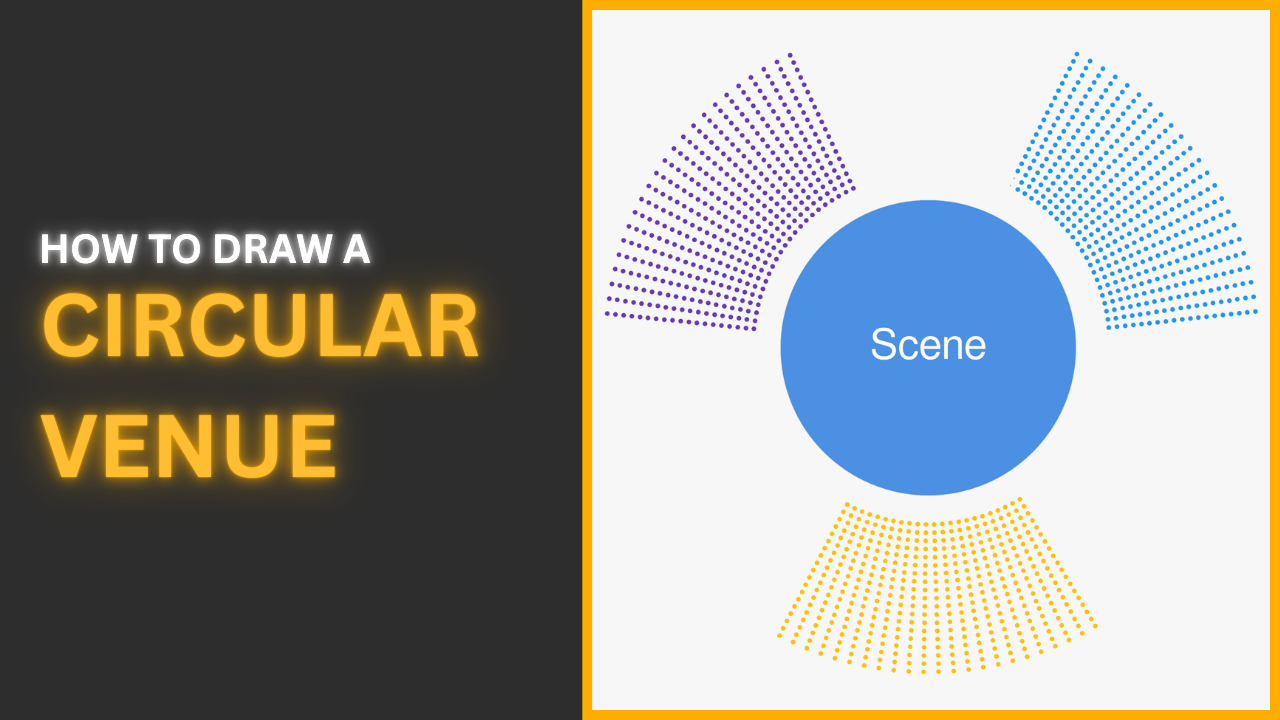
For many ticketing teams, circular venues are where seat map quality is tested the hardest. A map can look acceptable in static view, but once you start editing sections, assigning prices, or aligning rows across curved geometry, the gaps appear quickly.
That is exactly the problem Path-Based Transformation (PBT) solves in the Seatmap Editor.
Instead of forcing circular venues into straight section blocks, PBT allows sections to follow curved venue paths while keeping the operational side of the map intact. You get geometry that reflects the real venue shape, without moving to a separate editing model.
Why Circular Venues Are Hard in Practice
Circular venues create practical editing problems that are easy to underestimate:
- section edges that should follow one arc end up visually inconsistent
- row spacing becomes uneven near inner and outer curves
- row labels and boundaries drift when sections are moved or re-aligned
- multi-section alignment behaves unpredictably because geometry is non-linear
In other words, the challenge is not only drawing a curved shape. The challenge is preserving consistent seat logic and editable structure while that shape changes over time.
What PBT Changes in the Editor
PBT introduces a dedicated transformation mode for curved layouts.
It is not “just another slider,” and it is intentionally controlled:
- PBT is handled as its own transformation state.
- Conflicting transform modes are reset or disabled when needed.
- The Editor keeps predictable behavior by preventing incompatible combinations.
This matters because circular editing fails fast when multiple transformations stack unpredictably. PBT avoids that by design.
How It Works
Under the hood, PBT runs in two calculation phases:
- Position phase
Computes row paths, seat position mapping, tangents/perpendiculars, and seat angles along the curved path. - Boundary phase
Computes row padding, corner points, and offset paths for section outlines.
This split is important for editing performance and stability. Heavy position math and boundary math are separated, so recalculation can stay focused when you move or align sections.
PBT also uses virtual edge points for row-boundary calculations.
In simple terms: it avoids “edge distortions” on curved rows where first/last real seats alone are not enough to build stable outlines and label padding.
Persistence and Reload Stability
A major practical challenge with advanced transformations is save/load consistency. PBT addresses this by storing the transformation state in a persistence-safe way and recalculating detailed metrics on load.
That means teams avoid stale geometry snapshots and can continue editing confidently after reload, import/export, or handoff between users.
Real Scenarios Where This Helps
PBT brings clear value in common production scenarios:
- Arena setup before sales launch
Operations can model curved bowls accurately before publishing events, without manual correction passes. - Mid-cycle layout updates
When sections shift due to capacity or staging changes, the curved logic remains controlled instead of becoming brittle. - Cross-team consistency
Designers, operations, and integration teams work on one map model that stays structurally reliable. - Multi-section alignment on curved plans
Alignment logic iterates to converge and uses stable anchoring to reduce oscillation on non-linear geometry.
Bottom Line
Path-Based Transformation makes circular venues feasible at production quality inside the Seatmap Editor. It improves shape fidelity, keeps editing predictable, and protects existing ticketing workflows from unnecessary complexity.
Circular venues are now practical to model in the Editor. Try them out today by signing up for a demo.
