Earlier this year, we wrote about why traditional 2D seat maps — especially when paired with a “view from seat” — often outperform fully 3D maps. They load faster, feel clearer, and help users make decisions without friction. That hasn’t changed.
What has changed is how much spatial context a 2D map can provide.
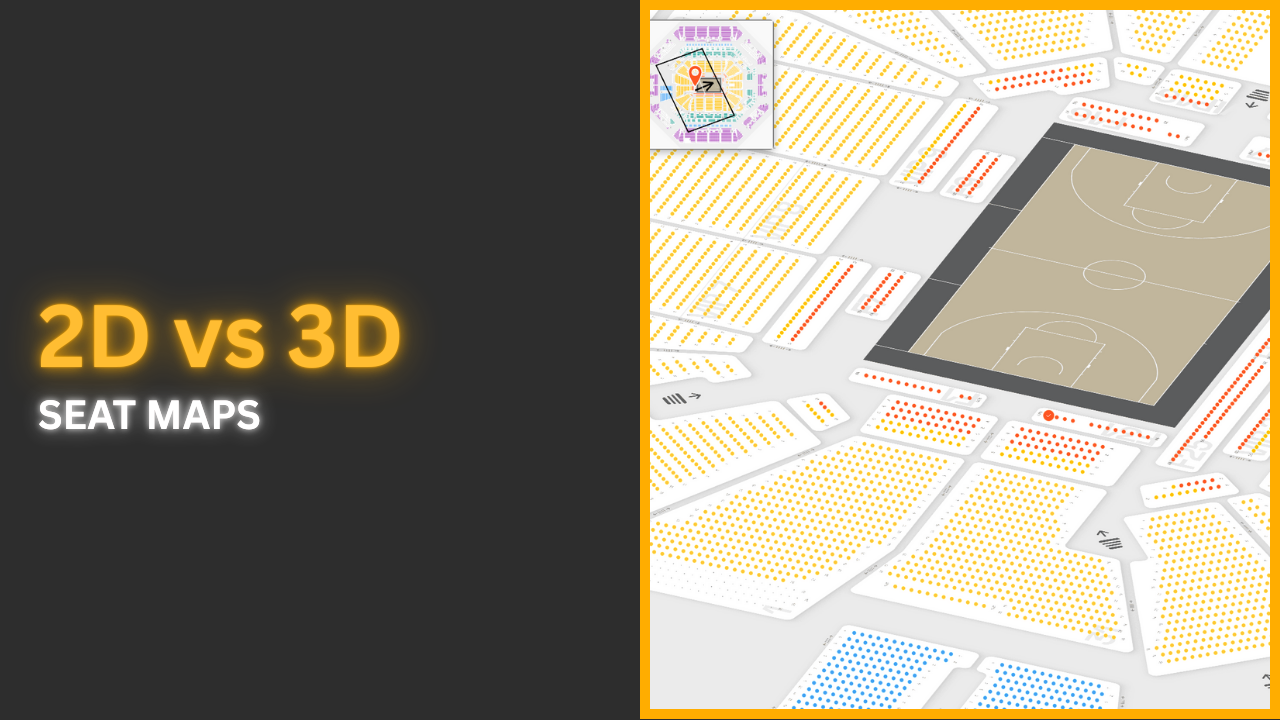
With recent updates to the Seatmap Pro Renderer, we’ve added the ability to introduce depth and perspective into a standard 2D map. The map remains fast, precise, and easy to interact with, but it now offers a stronger sense of orientation — especially in large venues.
More Depth, Same Clarity
Instead of turning the map into a fully three-dimensional scene, the Renderer applies controlled rotation, tilt, and perspective to the existing layout. Sections, rows, and outlines stay sharp and readable, but the venue gains a more natural sense of scale and direction.
This is particularly noticeable in stadiums and arenas, where understanding how sections relate to the field or stage matters just as much as identifying a specific seat. Users can visually grasp distance and layout without losing the clarity that makes 2D maps effective.
Why This Approach Works
Full 3D seat maps often look impressive, but they come with trade-offs: heavier rendering, more complex navigation, and less predictable seat selection. In many cases, those costs outweigh the benefits.
By keeping the underlying model 2D, Seatmap Pro avoids these problems. Seat selection remains precise, performance stays consistent, and integrations don’t become more complicated. At the same time, the added depth makes the map feel less flat and more intuitive to explore.
This approach works especially well with outline-focused views, where geometry and orientation are more important than detailed seat shapes. It also integrates seamlessly with existing features like zoom-based navigation, cart interactions, and availability states.
An Evolution, Not a Replacement
This isn’t about replacing 2D or competing with full 3D. It’s about extending what already works.
For teams who want a clearer, more spatial experience without sacrificing speed or usability, this updated rendering style offers a practical middle ground. It adds visual context where it helps, and stays out of the way where it doesn’t.
You can explore this mode today in the Seatmap Pro Playground.
